Showing posts with label berkeley. Show all posts

Wednesday, April 18, 2012

Arum palaestinum

Arum palaestinum

This is one of the very first plants I ever grew myself - from bulbs given to me when I was a teenager by a gardener in my hometown (yes, I still have them!). For me, in our mediterranean climate, the leaves are usually withering away by the time the flowers appear in spring. But perhaps that makes this dark flower stand out even more. I've placed it (a potted specimen) in front on this gray-white Centaurea ragusina for dramatic effect, but there is no reason why they could not grow together in the same planting.

The flowers, which attract flies for pollination, are mildly stinky (you have to literally put you nose into it to get a whiff) when they first open, and even slightly warm in temperature! The spathe (the enclosing bract) starts to fade to a deep burgundy or puce by the second day, though the spadix (the finger-like flower spike) remains very dark. Eventually, if well pollinated, the short cluster of orange-red berries will form in the place of the flower.

These mediterranean climate adapted bulbs go completely dormant in summer, returning with the cooling weather of fall and the promise of rain. The bulbs, if accidentally dug & sliced during this time, contain raphides (needle-shaped crystals of calcium oxalate) which can be very painful to hands or other tissue, so beware and handle with care (normal handling of this plant seldom if ever causes a problem).

Sunday, March 4, 2012

A corner of the garden . . .

Was inspired to take a photo of the garden today - such a pleasant day, and the light was beautiful.

Friday, May 6, 2011

An MGS No. Calif. Branch Advisory Board day in the Botanical Gardens at UC Berkeley. African Hill was beautiful.
The apricot flowers in the foreground are Tritonia gladiolaris (syn. T. lineata), which I grow in a pot in my garden. A beautiful and easy bulb that grows over winter, flowers in spring, and then is fully dormant through our dry summer - can't get much easier!

Wednesday, March 16, 2011

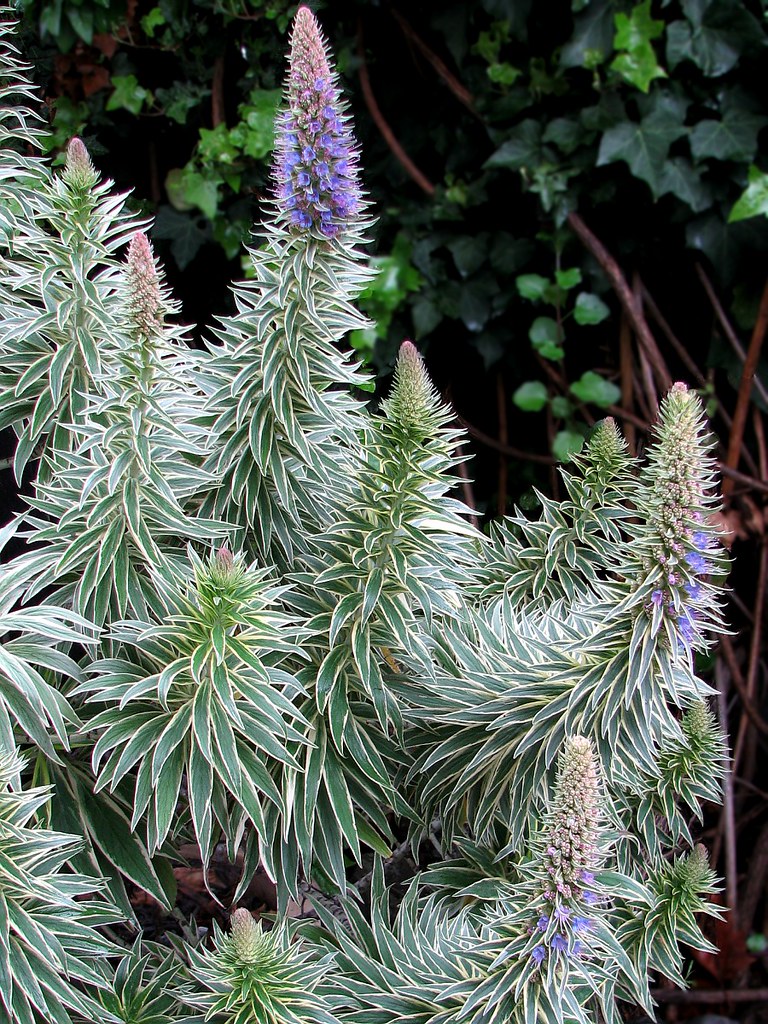
Variegated Echium candicans

Also called by some E. fastuosum, this shrubby perennial from the Madeira Islands is no stranger to our gardens here in California, but variegated foliage forms have become quite popular in this area of late. This clone I received from Kathy Echols, a local well-known plants woman, who selected it personally out of a large batch of variegated variants. I don't recall her given it a name. We grow this one in a large pot by our garden gate so we can enjoy it even when it is out of bloom, but this is a special moment with the spikes start to elongate and flowers color up.

Sunday, July 11, 2010

A typical July day here in Berkeley


© MMIX Earth Environment Service (annotated by me)

Folks are often perplexed by our local ocean fog. Even though it is easy to conceive that it has evil intent (we just saw it stay offshore until just before 4th of July fireworks were scheduled to go off, where it rushed onshore!), it happens for reasons that are pretty easy to understand.

The Pacific Ocean is a relatively cool body of water, which moderates our coastal environment, keeping it from becoming too hot in summer as well as too cold in winter. Our interior valleys, far from this influence, do experience much warm summer temps (and colder winter lows). As this warm interior air rises (orange arrows), it creates a vacuum that pulls in air from surrounding regions. Often this replacement air comes from the coast, pulling the ocean fog (created by the cooler ocean) along with it (blue arrows).

Sights of fog spilling over our coastal hills are very familiar to long time residents. Sometimes when a warm inversion layer holds the fog down, this cool air can only come in through the lowest points. The main 'low point' along this part of California coast is the Golden Gate, which is why it is so picturesquely half-shrouded in fog. Where does the fog go as it spills through this opening? First stop is Berkeley, where we live! I work in Oakland, which often warms up during the day in July, but back home in Berkeley, the fog can sit all day. My tomatoes are not particularly happy right now, and the rose is developing mildew, and many other warm-loving plants are in a sort of suspended animation, waiting for the occasional warmer day. But those that DON'T like the heat are enjoying a longer season that otherwise!

Monday, April 26, 2010

The dusty miller saga

Forever ago, when I was a teenager, my very first job was working in a local (Santa Clara) nursery. I loved being around all those plants and learning something new about them each day!

One day I was asked by a local gentleman, Mr. Crowley, if we have any ‘dusty millers’. So proud that I knew that we did and where they were, I escorted him directly to them. On our six-pak table, among bedding annuals and vegetable starts, were a few paks of plants with conspicuous felty white leaves, their labels announcing DUSTY MILLER (and nothing more). As I turned happily to see my customer’s expression, I was surprised to see a look of consternation. “Those are the wrong ones!” he scolded. Looking back at the plants, I suddenly realized that these were indeed different from those I’d seen previously labeled in the same manner. Nonplussed, I directed him to my boss who was just finishing up with another customer a few yards away. Later I saw the two of them standing over the same “wrong ones”, engaged in deep discussion. Apparently still unsatisfied, the customer left empty handed.

Years later, I learned that these new dusty millers were indeed a different plant – often still available today under this common name but known scientifically as Jacobaea maritima (syn Senecio cineraria). This is a good Mediterranean climate plant with divided leaves heavily covered with fine white hairs, justifying the common name. But not the one this fellow was looking for.

So, it turns out that I knew where Mr. Crowley lived (he was an acquaintance of my parents) and it was on my way home. Curious, after work was done, I rode my bike home making a slight detour to ride by his house. It was all clear when I stopped in front of his yard – a simple affair: a square of green lawn, bordered by junipers, but at regularly placed intervals were gray-white plants outlining the lawn edge. But some of these seemed to be missing – there were definite gaps in 3 places. As I was leaving, I noticed a full trash can on the street. The lid could hardly contain the contents – masses of ropy stems ending in a few gray-white felty leaves just like those in the garden.

I knocked on the door, but the house was dark and no one answered. As I left, I broke off a number of the stems that looked the least damaged. You see, I had recently learned that you could make new plants from old by striking cuttings, and I planned to experiment with these.

I had very good success in getting these cuttings to grow, and was able to study the plants a bit more closely now that they were in my possession. I came to learn that this ‘dusty miller’ was Centuarea ragusina, the Dubrovnik cornflower, from the Adriatic. When the plants were well-rooted, I now had several. I kept a few for myself, and took the other ten, small potted plants to Mr. Crowley’s house on my way to work one day. Again, no one was home, so I tucked them to the side of the porch with a note. When I returned home, my surprised parents informed me that I was expected at the Crowley’s for dinner where I also helped Mr. Crowley plant his unexpected gifts.

Many years later I wanted to put Centaurea ragusina in a garden but I could not find it through any of my usual sources. I had to substitute another gray leafed plant but I kept a look out for this species. Occasionally I felt I might have found it, only to be the victim of mistaken identity (the names of this and related plants are constantly confused with each other). One day, while visiting a nurseryman friend in France, I discovered Centaurea ragusina among his stock! Soon, gifted this by my generous friend, I had this plant again growing in my garden (as pictured above).

Wednesday, September 20, 2006

Aloysia citrodora - lemon verbena

Though native to South America (Argentina, Paraguay, Brazil, Uruguay, Chile, Bolivia, Peru), Lemon Verbena has been known in Europe since the 1600s. It was known and even named, but was not scientifically published authoritatively until the late 1700s. Once you know this plant it is easy to see why it would be one of the first brought back from these expeditions - the fragrant foliage (quite pleasantly lemon) endears even the most ambivalent.

The French perfume industry grows this plant en masse in Grasse, Cannes, Antibes, Nice, as well as some cooler winter areas (it is hardy to -5°C [23°F], using it for tea, flavorings, and scent (they make a wonderfully refreshing soap). The fragrant of the leaves is most intense if gathered when the plant is in flower and lasts very well when dried (in cool shade), making it a useful addition to potpourris.

This is a lax shrub, often leaning or spilling other its neighbors. Espalier is a good treatment, as is a thorough pruning back each year as the new shoots start to break from the naked stems (it is fully deciduous and late to start growing in spring). While not a particularly shapely plant, it is none-the-less a good candidate to plant close to a path (or spilling over support nearby) so that visitors will come in direct contact with the fragrant leaves. Fairly tolerant of a variety of growing conditions, it actually doesn't mind heavy soil - probably because it likes a bit more water than other plants (it can suffer leaf drop if too dry).