Showing posts with label garden. Show all posts

Wednesday, April 18, 2012

Arum palaestinum

Arum palaestinum

This is one of the very first plants I ever grew myself - from bulbs given to me when I was a teenager by a gardener in my hometown (yes, I still have them!). For me, in our mediterranean climate, the leaves are usually withering away by the time the flowers appear in spring. But perhaps that makes this dark flower stand out even more. I've placed it (a potted specimen) in front on this gray-white Centaurea ragusina for dramatic effect, but there is no reason why they could not grow together in the same planting.

The flowers, which attract flies for pollination, are mildly stinky (you have to literally put you nose into it to get a whiff) when they first open, and even slightly warm in temperature! The spathe (the enclosing bract) starts to fade to a deep burgundy or puce by the second day, though the spadix (the finger-like flower spike) remains very dark. Eventually, if well pollinated, the short cluster of orange-red berries will form in the place of the flower.

These mediterranean climate adapted bulbs go completely dormant in summer, returning with the cooling weather of fall and the promise of rain. The bulbs, if accidentally dug & sliced during this time, contain raphides (needle-shaped crystals of calcium oxalate) which can be very painful to hands or other tissue, so beware and handle with care (normal handling of this plant seldom if ever causes a problem).

Tuesday, April 17, 2012

Lotus jacobaeus

Lotus jacobaeus

The so called Black flowered lotus, for obvious reasons. Couldn't resist this offering by Annies Annuals. A quite little plant, now enjoying a warming trend in our weather. The continuous flowers are very surprising - usually takes visitors a bit of time to notice them, but notice they do! They are also very hard to photograph, becoming mere black holes in the photo. it is reportedly a biennial or short-lived perennial, so I'm trying to get some new starts from the only occasional seed pod that forms (have yet to germinate them).

Native of rocky sites on the Cape Verde islands, just off the coast of East Africa.

Sunday, March 4, 2012

A corner of the garden . . .

Was inspired to take a photo of the garden today - such a pleasant day, and the light was beautiful.

Friday, May 6, 2011

An MGS No. Calif. Branch Advisory Board day in the Botanical Gardens at UC Berkeley. African Hill was beautiful.
The apricot flowers in the foreground are Tritonia gladiolaris (syn. T. lineata), which I grow in a pot in my garden. A beautiful and easy bulb that grows over winter, flowers in spring, and then is fully dormant through our dry summer - can't get much easier!

Wednesday, March 16, 2011

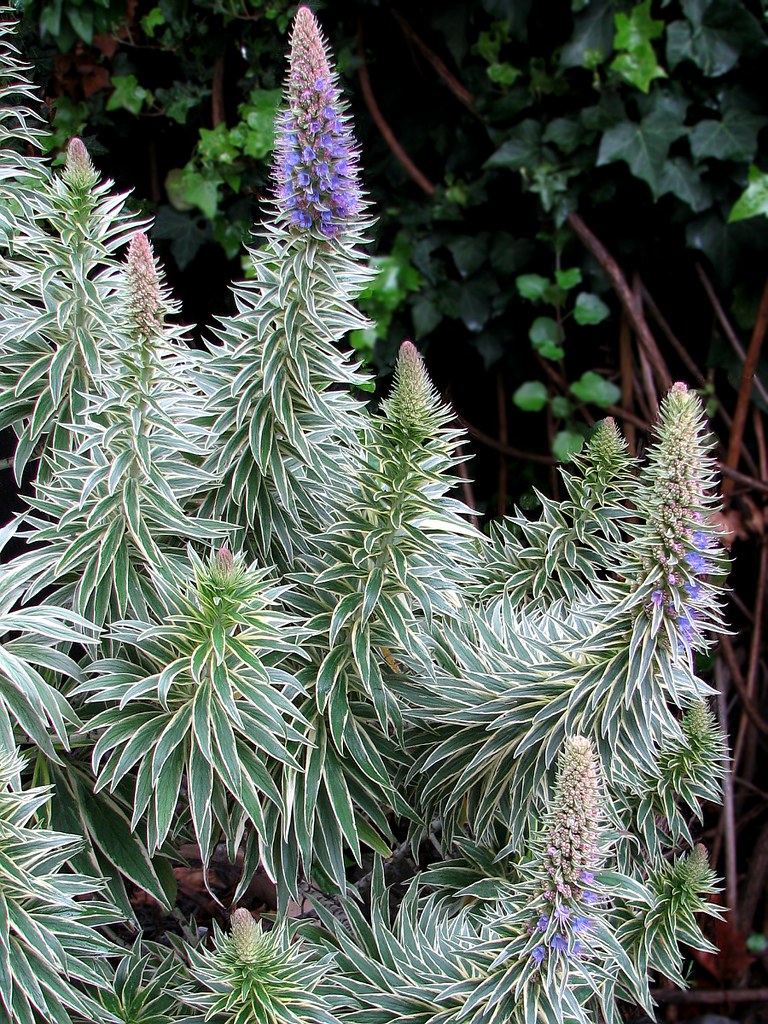
Variegated Echium candicans

Also called by some E. fastuosum, this shrubby perennial from the Madeira Islands is no stranger to our gardens here in California, but variegated foliage forms have become quite popular in this area of late. This clone I received from Kathy Echols, a local well-known plants woman, who selected it personally out of a large batch of variegated variants. I don't recall her given it a name. We grow this one in a large pot by our garden gate so we can enjoy it even when it is out of bloom, but this is a special moment with the spikes start to elongate and flowers color up.

Wednesday, June 30, 2010

Wednesday, November 4, 2009

what is a mediterranean garden - part IV

Continued from . . .

Now that we understand that our gardens can be a venue for all manner of activity, how to we design our gardens accordingly. Seating areas are always important - veritable rooms can be created outdoors, complete with walls if desired. Segmentation of even a small garden space can make it seem larger than before. Having space that are unseen until one arrives in them adds a pleasant surprise. Plus more than one person can feel 'private' in the same garden.

A paved generous pathway
between two garden rooms.
Le jardin provençaux de Pierre Bergé

Paved surfaces, preferably permeable, also help create the room-like quality to garden spaces. On a stable surface furniture can be placed, either permanently or spontaneously. There is also the added benefit that despite a cloud-break in the morning, the pleasant afternoon (not uncommon for mediterranean climate weather) can easily be enjoyed without having to endure soggy grass or ground.
      Paved of graveled surfaces also protect roots and keep the soil cooler/moister during our hot, dry summers. Many mediterranean climate adapted plants prefer to get their roots under such surfaces - it is like the stony terrain to which they are native. Perennials that spread at the roots will often be found moving to the edge of paving, deserting the supposedly better conditions of the open bed. By the same token, the painstaking removal of all stones from the soil is unnecessary. (this would not include a garden that is devoid of soil, the ground being composed on only stones - which is another problem)
Well designed paving adds a great deal to the 'bones' of a garden, providing interest and character regardless of whether plants are dormant (in summer, remember) or not at the peak. The design of such surfaces should be in keeping with the overall design. Craftspeople sometimes get carried away with their expression - their resulting art should not command undue attention away from the rest of the garden. it is better to create special places for such follies, creating the sense of surprise upon arrival mentioned previously.
      At all times, the material used for paving should be of a local source. Not only does this help ensure that your garden is in keeping with its environment, but also aligns with current green concepts (i.e. your material was not shipped from far away in addition to being torn from the natural landscape).

Straight-cut, stacked recycled concrete wall with tumbled crockery gravel, design by Shirley Watts (see Gardenporn blog article).

Recycling is always an option as well. There are an ever increasing number of salvage or recycle outlets opening throughout urban areas so that such material can be reused instead of dumped into a landfill. Be innovative. Open you might to the potential of any durable objects that could be used or incorporated into your surface.

Monday, November 2, 2009

what is a mediterranean garden - part III

Continued from . . .

OK, so the seasons are all different - so what? Why does that make a difference?
      I had occasion to travel to the Southeastern US for a wedding. Knowing of my interest in gardens, my wife and I were introduced to those locals who were gardeners themselves. As the wedding was held in early summer, there was already a fair bit of heat and humidity in the area. After spending hours being entertained indoors (with ample air conditioning) and admiring the garden outside through the windows, I decided to venture out to get a closer look. After stepping out the door, I was taken aback by just how hot it was and the humidity was already enveloping me like a warm wet towel! I abandoned my quest and retreated indoors. The host spotted me and informed me that she never goes into the garden after 10am or before 6pm during this time of year!

Le jardin provençaux de Pierre Bergé
Part of the beauty of a mediterranean climate is how many months of the years you can spend outdoors, at least much of the day. Sure, there'll be hot days when it is best to stay inside, or better yet find a corner in deep shade in which to sit where one can get the benefit of an occasional breeze. but much of the year, especially fall, winter, spring, there is very pleasant weather and clear skies. Doing anything that is possible outside becomes the norm. And consequently, planning your outdoor spaces to accommodate such activity become important.
      I once read that English gardens are meant for strolling, which means that it is generally not pleasant enough to tarry in one place or even sit still, and Mediterranean gardens are meant for sitting, meaning that in this climate spending a fair amount of time in the outdoor space is very pleasant, even desirable. In corporating different areas for eating, reading, relaxing, or even working in your garden will offer you the opportunity to learn this for yourself.

Wednesday, October 28, 2009

what is a mediterranean garden - part I

In the most recent issues of The Mediterranean Gardener, editor and current President of The Mediterranean Garden Society (MGS), Caroline Harbouri, states:
I have sometimes been asked what a mediterranean garden is, and have never been able to come up with a better answer than "simply a garden made in, and compatible with, a mediterranean climate".
I agree that there is no quick answer to this question, encompassing as it does the larger question of what is a garden at all. But, since reading this, I’ve found myself musing on the topic. Caroline admits her British bias (one she shares with many members of the MGS) in having revised her "earlier English assumptions about gardens" living in Athens, Greece for almost 40 years.
      This got me to wondering about my own earlier assumptions.
      We had typical suburban yards in my post-WWII neighborhood in Santa Clara, California – lawns, a token shade tree, a few foundation shrubs against the house. Not particularly exciting, or distinctive, each one interchangeable with another. Some lawns were softer, or sturdier, or some of a friend’s parents allowed rough activities where another would not. There was even the wife of a neighbor, who we never saw in person – we only heard her scold us through a screened window if we ever inadvertently happened to step on the corner of their pristine lawn (consequently we would dare each other routinely just to see if she were watching!).
      But my school was in another, older part of town. Here, the houses were all distinctly different, and the plantings around them unlike each other or anything else. I thought of these as gardens – not mere yards. One would have vegetable, fruit trees, and flowers, in a charming disordered jumble. Other was full of semi-tropical wonders, with intoxicating fragrant flowering ginger, strange bird of paradise. Another was full of all manner of ancient found objects, arranged with loving care, half museum, half cabinet of curiosities. A large grand home, built in 1892 by Charles Copeland Morse, of the Ferry Morse Seed Company, was singular again – very Victorian grounds with a huge Southern Magnolia (M. grandiflora) as tall as the elevated 3 storey, turreted mansion.
      I would often walk home from school (having spent my bus fare on a treat) through this collection of unique and unusual properties. Each had a character all its own. Many of the plants remain familiar to me even though I only learned their names many years later when I became interested in botany and horticulture. There were stories embedded in each, the individual personalities of each owner spilling out into the garden. Year ‘round, there was always something interesting and even surprising happening in these gardens.
      Born and raised in California, the climate I came to know only later as mediterranean was all I knew. So, in later years, learning the definition and distinction of the world's five mediterranean climates, I rediscovered some familiar themes – those of childhood experiences. I saw the source of many of these outdoor living spaces – Italy, Spain, Southern France, Greece. I saw the culture of how to live in this benign climate and understood it from my own experience. Many of the preconceived notions that gardeners had about what a garden is were always foreign to me, and now I understood why. The mediterranean climate, and how to live with it, is what I had always known.

Saturday, December 20, 1997

The current state of my garden

My small parcel of land is in sad disarray at the moment. Not that my climate precludes having 'something doing' at this time of year - indeed, there seems to be activity regardless of my neglect, which is the real cause of the problem. Fall clean-up never really happened, and the 'Christmas clear-away' was also missed!! I'm hoping for a 'New Year's new start', but there is a significant amount of construction and painting happening to my building in the next weeks, so I'm sure that will cause a disruption to my plans as well!

The lower slope, which faces south west, is currently blooming madly with Oxalis pes-caprea! Quite bright to those unfamiliar with this horrible weed, but striking fear into the hearts of those interested in planting other winter growing plants. We have the pentyploid (2.5 the normal chromosomes) mutant which is much larger and far more vigorous than the type (diploid) species. Though sterile (due to the odd number of chromosomes), it more than makes up for it in all other ways. California is lousy with the stuff, the only saving grace being its short season of growth. We removed and sifted out many bulbils last summer, but those that remain seem to be thriving because of our efforts! I merely pull handfuls of the succulent greenage from areas where I have other plants trying to survive, and it seems to make a bit of difference (fewer and smaller Oxalis) over time.

Meanwhile, Geranium incanum is getting ready for an early spring bloom, my plant cascading gently over a wall at the base of this slope. I pull away the mat of stems under those on top of this spill, thinning it out and creating a more delicate effect (this plant can be a thug!).
A shrubby Velvet Groundsel (Roldana petasitis, = Senecio p., Cineraria p.) is growing close by, its large, rounded, scallop-lobed, felty green leaves always attracting interest and an occasional 'feel' from passerbys. Its deep maroon brown-red, clusters of flower buds are interesting until they open to reveal the raggedy yellow daisies (at which point I promptly remove them). Other plants in evidence (among the disarray of weeds and overgrowth!) are Echium pininnana and Geranium psilostemon. The former is a new plant for me, and I am pleased with the rapid growth of its rosette, promising a handsome, tall spike of flowers this spring. The latter is in a 'leaf stage' - a nice clump of rounded, lobed leaves (magenta flowers will surmount this most of spring and summer). Coleonema pulchrum 'Sunset Gold' is very bright right now, looking much like a gold-toned heather. I mean to relieve its 'lumpy' shape by taking selected cuttings when I get a chance, finding that it looks best when allowed to grow in the more horizontal, up-swept form typical of this cultivar. A large unnamed Verbascum has made a huge yellowish rosette in this part of the garden, much to the chagrin of my wife, who constantly reminds me that I said it would be smaller in size (how was I to know! - it had always been smaller in the poorer soils and minimal irrigation in which it grew before!). She feels it sets the planting 'off balance', but is willing to wait for flowering and seed gathering.

Also far too large is Agave angustifolia 'Variegata', planted across the stairs from the site just discussed, and protruding obnoxiously into the walking space! While it is unquestioningly very beautiful, its rounded form of stiff, spiky leaves, a soft celadon green with a broad creamy edge, bedecked with deep red-black thorns, it must go soon! I thought it would flower before growing larger (I seem to have this problem, I guess!) but it does not seem ready to give up growing in girth just yet. I'm going to need to rent a large pry-bar and try and lift this guy out of his bed and move him (somehow) down to a public succulent garden here in town, where he will be a featured attraction, no doubt!

Tecomaria capensis, a melon orange form, towers behind, apparently not minding its shabby seed-pod crown, still throwing out a new flower spike or two, even though the weather long ago cooled lower than it usually prefers. Its dwarf yellow cousin is behind, shooting out long, lax branches in all directions, seeking to claim more horizontal space than its vertical companion. It cascades over the largest Agave attenuata in the garden, whose large, soft, wavy, sculpted leaves were slightly damaged in the last hail-storm, but now are being replaced quickly by fresh, new growth. I hope for a nice, tall, 'foxtail' inflorescence this spring - a thick spike densely clothed in yellow flowers and with a characteristic limp, 'crooked' top. While I feel the garden is a pretty sad sight right now, it does still cause some to stop and admire (or perhaps they are aghast!). Many of you who have read my ramblings before have imagined a large, spacious few acres to contain all that I explain! It is a very modest space, and perhaps much of the content is only evident to the gardener himself (moi). But then gardens are often that way, especially when the gardener has other things to do beside spend the days tending that bit of the natural world (sigh!).