Thursday, July 29, 2010

Sedum rupestre 'Angelina'


Many years ago, I first happened upon Sedum rupestre growing happily in the garden of a bed & breakfast where my wife and I were staying. When I commented on how interesting the arched flower spikes were, the garden owner, who did not know the species name, encourage me to take a few pieces home.

At the time, I was growing Sedum reflexum 'Blue Spruce', a cultivar that looks very similar, so I was careful to plant this new introduction some distance from the other. Out of flower they are very hard to tell apart, and both have yellow flowers. It is the flower spikes themselves that makes identiy easy (S. reflexum flower spikes are upright from start to finish).

Subsequently, we came to plant this golden form on S. rupestre in the raised planter you see here, topped with a rusty iron grate, the golden-green color making a nice contrast to the dark iron as well as the darker foliage all around. You can see the normal gray form of the species in the foreground. I was pleased to see the flowering this spring - a means to verify that 'Angelina' is indeed a cultivar of S. rupestre (it is sometimes listed erroneously as another species).

Sunday, July 11, 2010

A typical July day here in Berkeley


© MMIX Earth Environment Service (annotated by me)

Folks are often perplexed by our local ocean fog. Even though it is easy to conceive that it has evil intent (we just saw it stay offshore until just before 4th of July fireworks were scheduled to go off, where it rushed onshore!), it happens for reasons that are pretty easy to understand.

The Pacific Ocean is a relatively cool body of water, which moderates our coastal environment, keeping it from becoming too hot in summer as well as too cold in winter. Our interior valleys, far from this influence, do experience much warm summer temps (and colder winter lows). As this warm interior air rises (orange arrows), it creates a vacuum that pulls in air from surrounding regions. Often this replacement air comes from the coast, pulling the ocean fog (created by the cooler ocean) along with it (blue arrows).

Sights of fog spilling over our coastal hills are very familiar to long time residents. Sometimes when a warm inversion layer holds the fog down, this cool air can only come in through the lowest points. The main 'low point' along this part of California coast is the Golden Gate, which is why it is so picturesquely half-shrouded in fog. Where does the fog go as it spills through this opening? First stop is Berkeley, where we live! I work in Oakland, which often warms up during the day in July, but back home in Berkeley, the fog can sit all day. My tomatoes are not particularly happy right now, and the rose is developing mildew, and many other warm-loving plants are in a sort of suspended animation, waiting for the occasional warmer day. But those that DON'T like the heat are enjoying a longer season that otherwise!

Wednesday, June 30, 2010

Wednesday, June 23, 2010

'Gilva' & 'Gilva'


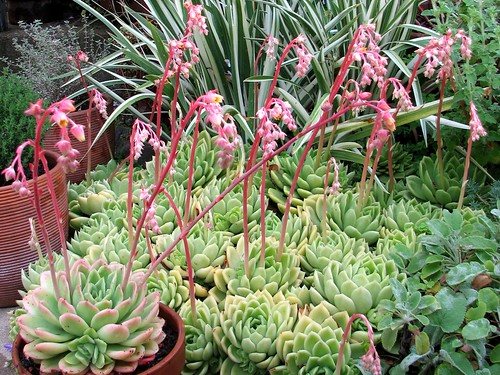
The main succulent in this photo should be familiar to those of you who have seen my garden. It is a hybrid Echeveria I've grown for many years under the name 'Gilva' (discovered and described by Eric Walther in 1935 and presumed to be a E. agavoides × E. elegans cross). The plant habit is very similar to E. elegans, offsetting freely and quickly making a nice ground cover. The arching (like E. elegans) flower spikes branch dicotomously (in two - unlike E. elegans but like E. agavoides).

Notice the potted plant in the left foreground. This is being distributed currently by Succulent Gardens as E. 'Gilva'. The rosettes are strikingly similar, perhaps larger, seemingly slower to offset, and decidedly flushed pink at their tips (the plant above NEVER flushes pink - instead turning yellow when stressed). it also produces many more flower stems per rosette, which are un-branched and whose flowers are a bit larger, with a more distinct yellow tip to the petals.

I've been growing these side by side for some time now and while it is sometimes hard to tell them apart, when they reach this stage it is clear they are different plants. I still prefer the original (to me) 'Gilva' as it makes a much more effective ground cover and there are always lots of offsets to start new colonies or give away. The pinker 'Gilva' is certainly a good pot specimen, perhaps better than the former which quickly outgrows any pot.

Monday, April 26, 2010

The dusty miller saga

Forever ago, when I was a teenager, my very first job was working in a local (Santa Clara) nursery. I loved being around all those plants and learning something new about them each day!

One day I was asked by a local gentleman, Mr. Crowley, if we have any ‘dusty millers’. So proud that I knew that we did and where they were, I escorted him directly to them. On our six-pak table, among bedding annuals and vegetable starts, were a few paks of plants with conspicuous felty white leaves, their labels announcing DUSTY MILLER (and nothing more). As I turned happily to see my customer’s expression, I was surprised to see a look of consternation. “Those are the wrong ones!” he scolded. Looking back at the plants, I suddenly realized that these were indeed different from those I’d seen previously labeled in the same manner. Nonplussed, I directed him to my boss who was just finishing up with another customer a few yards away. Later I saw the two of them standing over the same “wrong ones”, engaged in deep discussion. Apparently still unsatisfied, the customer left empty handed.

Years later, I learned that these new dusty millers were indeed a different plant – often still available today under this common name but known scientifically as Jacobaea maritima (syn Senecio cineraria). This is a good Mediterranean climate plant with divided leaves heavily covered with fine white hairs, justifying the common name. But not the one this fellow was looking for.

So, it turns out that I knew where Mr. Crowley lived (he was an acquaintance of my parents) and it was on my way home. Curious, after work was done, I rode my bike home making a slight detour to ride by his house. It was all clear when I stopped in front of his yard – a simple affair: a square of green lawn, bordered by junipers, but at regularly placed intervals were gray-white plants outlining the lawn edge. But some of these seemed to be missing – there were definite gaps in 3 places. As I was leaving, I noticed a full trash can on the street. The lid could hardly contain the contents – masses of ropy stems ending in a few gray-white felty leaves just like those in the garden.

I knocked on the door, but the house was dark and no one answered. As I left, I broke off a number of the stems that looked the least damaged. You see, I had recently learned that you could make new plants from old by striking cuttings, and I planned to experiment with these.

I had very good success in getting these cuttings to grow, and was able to study the plants a bit more closely now that they were in my possession. I came to learn that this ‘dusty miller’ was Centuarea ragusina, the Dubrovnik cornflower, from the Adriatic. When the plants were well-rooted, I now had several. I kept a few for myself, and took the other ten, small potted plants to Mr. Crowley’s house on my way to work one day. Again, no one was home, so I tucked them to the side of the porch with a note. When I returned home, my surprised parents informed me that I was expected at the Crowley’s for dinner where I also helped Mr. Crowley plant his unexpected gifts.

Many years later I wanted to put Centaurea ragusina in a garden but I could not find it through any of my usual sources. I had to substitute another gray leafed plant but I kept a look out for this species. Occasionally I felt I might have found it, only to be the victim of mistaken identity (the names of this and related plants are constantly confused with each other). One day, while visiting a nurseryman friend in France, I discovered Centaurea ragusina among his stock! Soon, gifted this by my generous friend, I had this plant again growing in my garden (as pictured above).

Sunday, November 8, 2009

what is a mediterranean garden - part V

Continued from . . .

taking a break - photo by Marialuisa Wittlin, on Flickr

Your mediterranean climate garden should allow for you to live/enjoy your life. It is easy for us to feel that if we are out in our private landscape, there is always work to be done (and we should be doing it). This can be true, but we also deserve to use the garden for doing things other than keeping up the garden. It might take a little practice, but I imagine anyone can master it.
      Keeping to simple, low maintenance designs and expectations will help. because our gardens are virtually year 'round, we need not work under a deadline to ensure that one seasonal opportunity to make the garden really shine. Our plant choices might be in their peak at any season, depending upon species. In fact, with a little cleverness, we can have plants coming into their best at specific times, different from their garden mates. Except for the overall summer dormancy (during which we may still find some plants performing), there can be a few or a number of plants in bloom and with seasonal interest through fall, winter, and spring.

Easy care Aloe arborescens
blooming in winter in
southern Italy - photo
by viaggiealtro on Flickr

In this way, no time of year is overwhelming. Some newcomers to this type of garden are daunted by the fact that there could be something to do any day of the year. But if one can shed the expectation that the garden is inevitably a lot of work, then the pleasures of puttering in the garden throughout the year are found. The more your plant selection is aligned with the mediterranean climate, the more your charges will work for you instead of requiring mitigation due to inappropriate growing conditions.

Wednesday, November 4, 2009

what is a mediterranean garden - part IV

Continued from . . .

Now that we understand that our gardens can be a venue for all manner of activity, how to we design our gardens accordingly. Seating areas are always important - veritable rooms can be created outdoors, complete with walls if desired. Segmentation of even a small garden space can make it seem larger than before. Having space that are unseen until one arrives in them adds a pleasant surprise. Plus more than one person can feel 'private' in the same garden.

A paved generous pathway
between two garden rooms.
Le jardin provençaux de Pierre Bergé

Paved surfaces, preferably permeable, also help create the room-like quality to garden spaces. On a stable surface furniture can be placed, either permanently or spontaneously. There is also the added benefit that despite a cloud-break in the morning, the pleasant afternoon (not uncommon for mediterranean climate weather) can easily be enjoyed without having to endure soggy grass or ground.
      Paved of graveled surfaces also protect roots and keep the soil cooler/moister during our hot, dry summers. Many mediterranean climate adapted plants prefer to get their roots under such surfaces - it is like the stony terrain to which they are native. Perennials that spread at the roots will often be found moving to the edge of paving, deserting the supposedly better conditions of the open bed. By the same token, the painstaking removal of all stones from the soil is unnecessary. (this would not include a garden that is devoid of soil, the ground being composed on only stones - which is another problem)
Well designed paving adds a great deal to the 'bones' of a garden, providing interest and character regardless of whether plants are dormant (in summer, remember) or not at the peak. The design of such surfaces should be in keeping with the overall design. Craftspeople sometimes get carried away with their expression - their resulting art should not command undue attention away from the rest of the garden. it is better to create special places for such follies, creating the sense of surprise upon arrival mentioned previously.
      At all times, the material used for paving should be of a local source. Not only does this help ensure that your garden is in keeping with its environment, but also aligns with current green concepts (i.e. your material was not shipped from far away in addition to being torn from the natural landscape).

Straight-cut, stacked recycled concrete wall with tumbled crockery gravel, design by Shirley Watts (see Gardenporn blog article).

Recycling is always an option as well. There are an ever increasing number of salvage or recycle outlets opening throughout urban areas so that such material can be reused instead of dumped into a landfill. Be innovative. Open you might to the potential of any durable objects that could be used or incorporated into your surface.